Colin Nagy | September 10, 2026
The Doxa Orange Edition
On blinding dials, underwater legibility, and my own dive set-up.
Colin here. Vintage dive watches are one of my recurring wormholes. As much as I love a beat-up Rolex Sub, I’m also drawn to the smaller names and the peculiar decisions that went into making their watches.
One is Doxa, and specifically their SUB 300 Professional. Introduced in 1967, it has a cushion-shaped case, a comfortable “beads of rice” bracelet, and an oversized minute hand. But the most memorable part is the dial, which is about the same hue as a traffic cone.
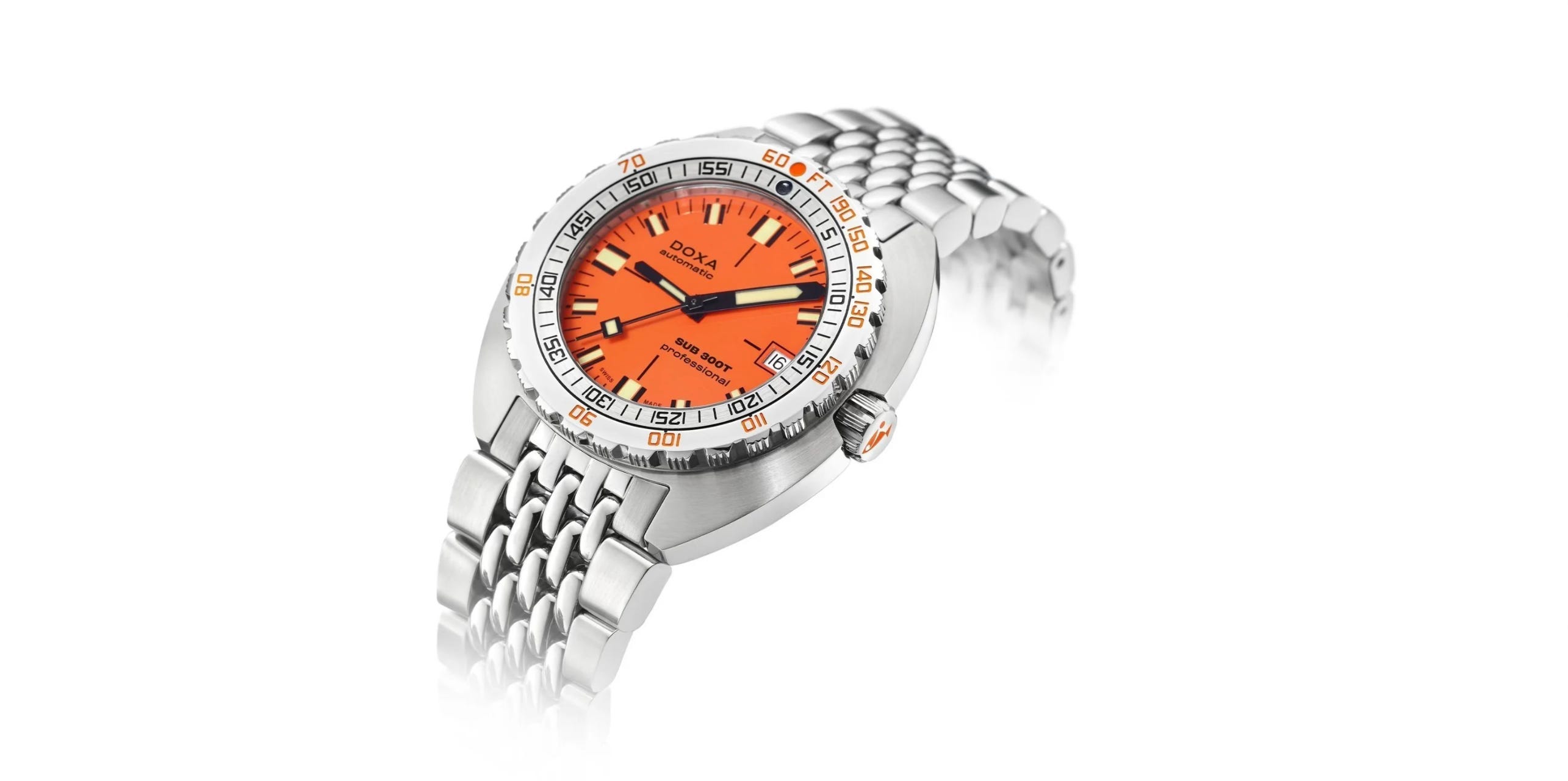
The bezel is engraved with no-decompression limits drawn from US Navy dive tables. It gave divers a reference for how long they could remain at a given depth without requiring decompression stops on the way back up. A useful bit of information to have on your wrist, at least in that context.
Why is this interesting?
The orange began with a question of underwater legibility. According to Doxa’s history, Urs Eschle, who led the project, worked with diver Claude Wesly and a team testing visibility in Lake Neuchâtel. They settled on orange. What now looks like a fairly aggressive style choice came out of an effort to make the watch easier to read underwater.
The watch also found its way into the right company. In 1968, Jacques Cousteau’s US Divers became its distributor in the Americas. The novelist Clive Cussler made an orange Doxa part of his adventurer Dirk Pitt’s regular equipment across several novels. Between the real expeditions and the fictional ones, the orange became shorthand for a whole midcentury fantasy of exploration, Calypso and salvage barges and diving bells.
That association is a large part of the appeal for me. The design gives you something to look at; the people and stories around it give you somewhere to go. A small orange dial can send you off reading about an expedition or tracking down a battered paperback.
Doxa had a bit of a rough passage through the quartz crisis. The Jenny family acquired the business in 1997, and a SUB 300T reissue followed in 2002, bringing the familiar design back to market.
When I dive, though, I use a Suunto computer. It estimates nitrogen loading as my depth changes, rather than having me work from the fixed limits engraved on a bezel. I’m not looking to a vintage mechanical watch to replace it. If anything, the bezel on my Tudor Pelagos FXD, worn with a comfy Garmin strap on my left wrist, could track my dive time. But again, the computer does too. Still, who doesn’t want to look cool?
Knowing how the Doxa came to look the way it does makes me like it even more. The oversized minute hand and the numbers around the bezel are evidence of someone thinking carefully about exactly what a diver needed. Even the loudest thing about it had a practical reason. I could appreciate the orange without knowing any of this, because it jumps out in a sea of same-same watches. But the thought of someone testing dials in a Swiss lake, trying to make a better instrument, is what keeps me interested. (CJN)