Michael Hastings-Black | July 14, 2026
The Slow Motion Soccer Edition
On energy, intelligence, and the speed of play.
Michael Hastings-Black (MHB) is a researcher & brand strategist. He runs the agency AskMHB, and hosts the interview series Spin That Bottle. Past contributions to WITI include the Antimatter Road Trip, Inherited Ceramics and World Cup Squad editions.
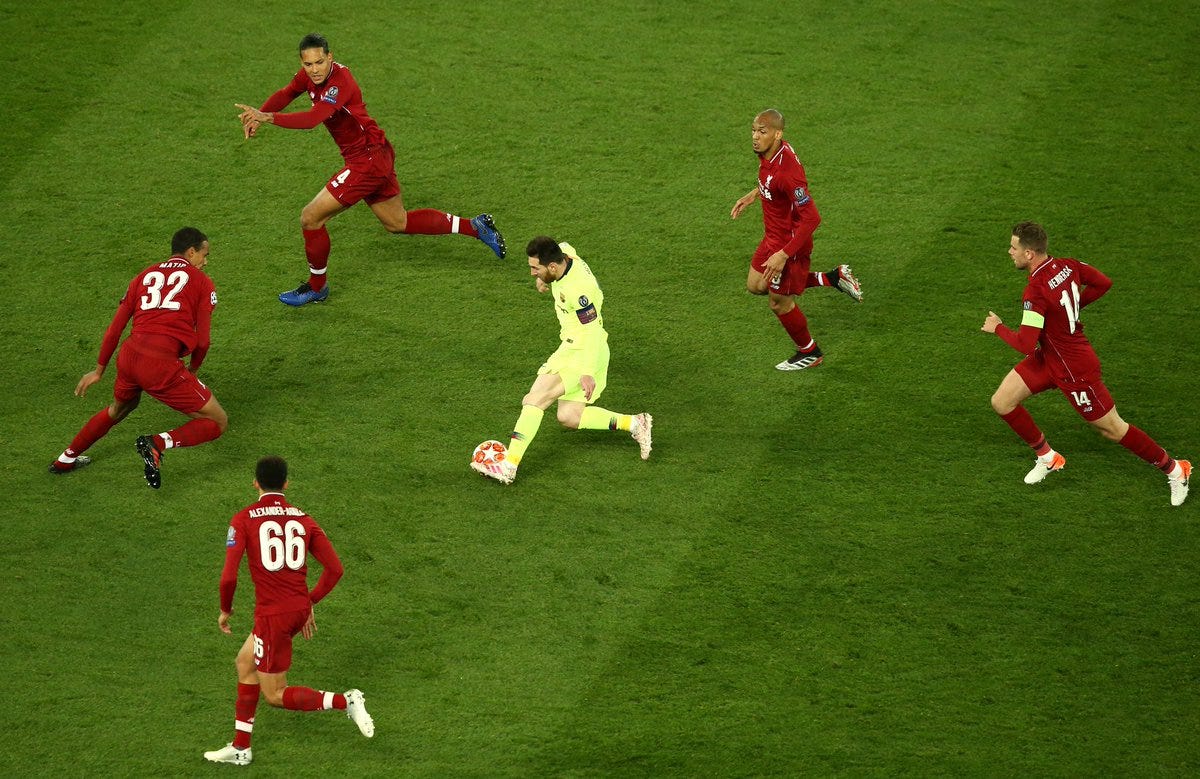
Michael here. Footballing legend turned pundit Thierry Henry said of the French winger Michael Olise: “He doesn’t play the game, he thinks the game.” Olise, who will play against Spain in a World Cup semi-final later today, reads the field with his brain before he runs the field with his legs, anticipating a play well before it happens instead of reacting once it does.
This perfectly captures how some of the best players on the pitch can at times seem like they’re moving in slow motion. They casually glide past opponents. They jog while others sprint. Defenders may close on them at full pace, yet somehow never arrive in time to make an impact.
Why is this interesting?
Soccer at the highest level is a game about speed, and some of the players who look like they use the least of it are often managing it best. There are two different ways to pull that off.
The first is Olise’s way: you move in what looks like slow motion, but you’re not actually slow. Your legs move at a normal pace, or even a fast one; your brain just got there first. Scouts and pundits routinely describe Olise’s dribbling style as languid, and say that he seems to operate on his own tempo, unaffected by the pace of everything happening around him. None of that shows up as reduced effort in his numbers. He’s one of the most heavily used wingers in Europe this season, high in dribbles attempted, crosses, and minutes played. The appearance and the workload coexist; the languidness is a visual effect of his anticipation.
Most of us watch or play soccer reactively. The ball moves, then we move. A player like Olise is scanning the field constantly, so that by the time the ball reaches him he already knows where the next three options are. Sports scientists call this temporal dilation. Composed players aren’t actually perceiving time more slowly than those around them. Their brains are just better at predicting what comes next, so they’re preparing their next move while everyone else is still processing the current one. The stillness is a byproduct. The speed was spent earlier, in the reading rather than running.
This isn’t a new phenomenon. Colombia’s Carlos Valderrama built an entire career on it, forty years before Olise. He was known for a ‘lazy’ playing style and a lack of pace, but the reputation missed the point. He barely needed pace, because he read a pass into space before the defense had thought, or tried, to close it down.
They’re fast in the sense that actually decides games, which is arriving at the optimal decision, and taking action, before anyone else.
The second way is seen with the GOAT Lionel Messi. It’s a different mechanism even though it produces the same visual effect. Because Messi is barely moving. Through this World Cup’s group stage, Opta tracked 618 outfield players who’d logged at least 90 minutes. Messi ranked first amongst them in goals, with six. He ranked 618th, dead last, in distance covered per 90 minutes, at 8.1 kilometers.
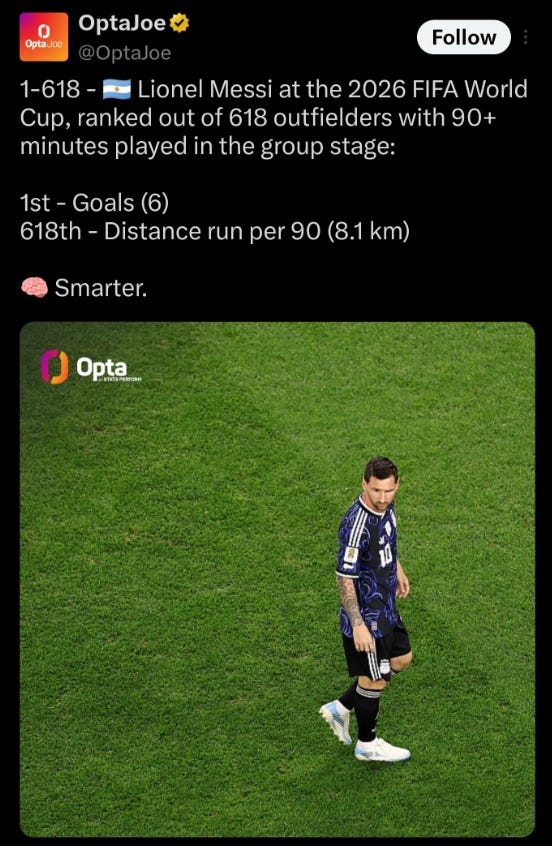
Some of that is Olise’s trick. Messi reads the game as well as anyone alive, so he’s rarely caught wrong-footed or forced into an unnecessary sprint.
But a lot of it is something else: at 39, and playing a role built around him rather than around (any) defensive work, Messi is simply excused from most of the running. He doesn’t track back. He doesn’t press. His teammates cover that ground so he doesn’t have to.
Messi isn’t appearing slow the way Olise is. He’s actually playing in slow motion, on purpose, and getting away with it because when the ball does arrive, his analysis and actions are still fast enough to produce six goals out of 8.1 kilometers.
Both versions rely on the same underlying idea, which is that a player’s speed of thought is often more valuable than speed of motion. Sometimes the spirited player who covers every blade of grass is just reading the game wrong, while the slow player is ambling toward victory. (MHB)