Todd Osborn | December 16, 2025
The Ford XGT-3 Edition
On a historic 1966 race car that never raced—and is now up for auction.
Todd Osborn (TO) is a United States Air Force Weapons Systems veteran. He is currently building a flight school.
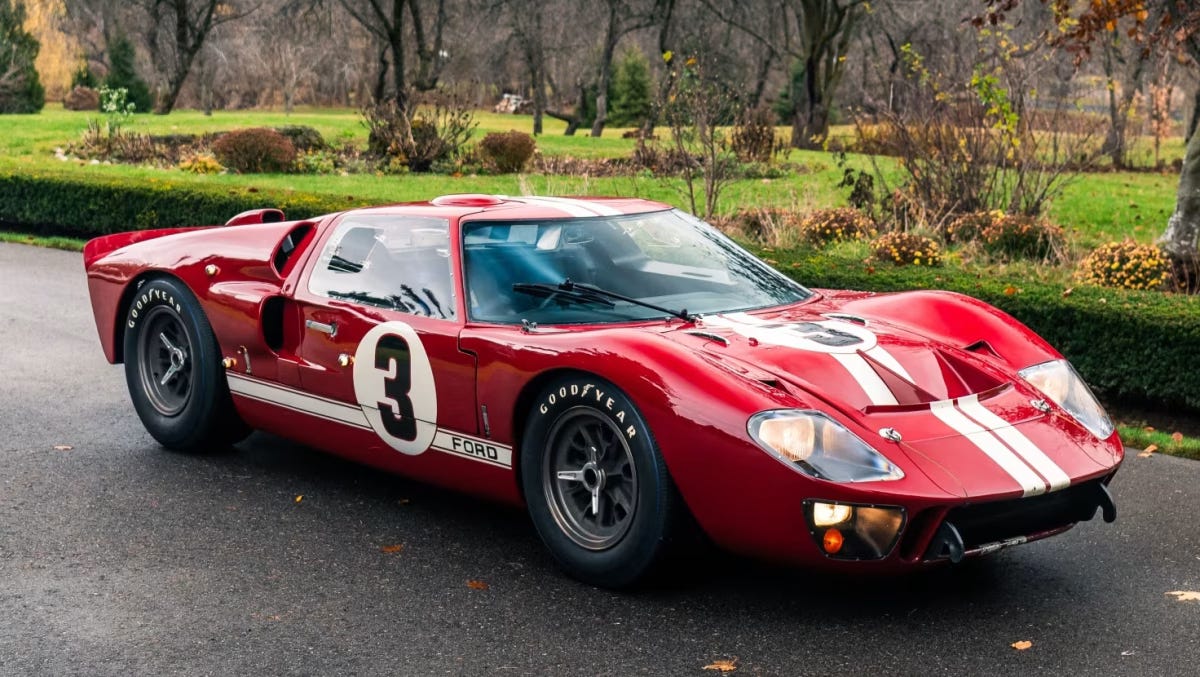
Todd here. This January, a very unique piece of Ford history is crossing the auction block. But unless you’re an uber-nerd for 60s racing, you might scroll past it thinking it’s just another Ford GT40 MKII.
The car is actually the ultra-rare chassis XGT-3, often called “the most original MKII in existence.” Built with a special factory lightweight body to challenge Ferrari, while it looks like other MKII’s, it’s actually the misunderstood mechanical bridge between the experimental small-block prototypes that Ford killed and the 7-liter monsters that eventually ruled Le Mans.
The backstory is pure corporate politics. Originally, Ford collaborator Alan Mann Racing built two lightweight GT40s (AM GT-1 and GT-2) using custom Abbey Panels chassis, narrower roof sections, and hand-formed aluminum bodies. Powered by small-block Ford engines, they were very fast, but fragile, and failed to finish at Sebring in 1966.
This spooked the Ford executives in Dearborn. Concerned that these lighter cars might either outlast Ford’s official heavy-hitting MKIIs, or fail dramatically on a global stage, Ford gave Mann an ultimatum: switch to the 427-cubic-inch MKII machinery if you want to keep the factory money. To comply, Mann ordered three MKII-spec chassis: XGT-1, XGT-2, and XGT-3. These were built at manufacturer Shelby American’s famed LAX facility, right by the airport runways, where Mann’s crew worked (likely awkwardly) alongside Shelby and Holman-Moody personnel.
Why is this interesting?
By May 1966, with Le Mans preparation in full panic mode, Ford had decided to halt progress on XGT-3 in order to conserve manpower and parts. XGT-1 and XGT-2 went to France, and both were again fast but broke down. XGT-3, meanwhile, sat unfinished. It was only completed after Ford’s historic 1-2-3 sweep in June, which ended Ferrari’s dominance of Le Mans. So, instead of a race car, XGT-3 debuted as a prop for Ford’s post-Le Mans “Victory Tour.”
It was initially painted to look exactly like the black and white Bruce McLaren/Chris Amon winning car (P/1046) to sell the victory to the American public, before eventually being repainted in the correct Alan Mann red and gold livery.
This history hits close to home because my father, Paul Osborn, was a Ford engineer who spent years in the trenches of GT40 restoration. He was one of the four engineers who volunteered thousands of hours to restore chassis P/1032 (another Holman-Moody MKII) to its 1966 Le Mans spec for the Indianapolis Motor Speedway Museum. If you follow the market, that chassis number might sound familiar. P/1032, the very car my dad poured five years of his life into, sold earlier this year at RM Sotheby’s in Miami for $13.2 million, a record-shattering price for a Ford GT40.
So when XGT-3 crosses the block in January, I won’t just see a shiny lot number. I see a fascinating test of the market. XGT-3 is a “pure” MKII built for battle, but it lived its life as a showpiece - an “Ambassador Car” rather than a “Race Warrior.” Without the combat record of a car like P/1032, my bet is it won’t command the same eight-figure sum, likely landing in the high seven figures instead. But regardless of the hammer price, it represents the exact point where Ford’s ferocious engineering program turned into legend—a weapon that never fired a shot, but was used to tell the world who won the war. (TO)