Unknown Author | February 19, 2026
The Campa Cola Edition
On nostalgia, CPGs, and what marketing budgets can't replicate.
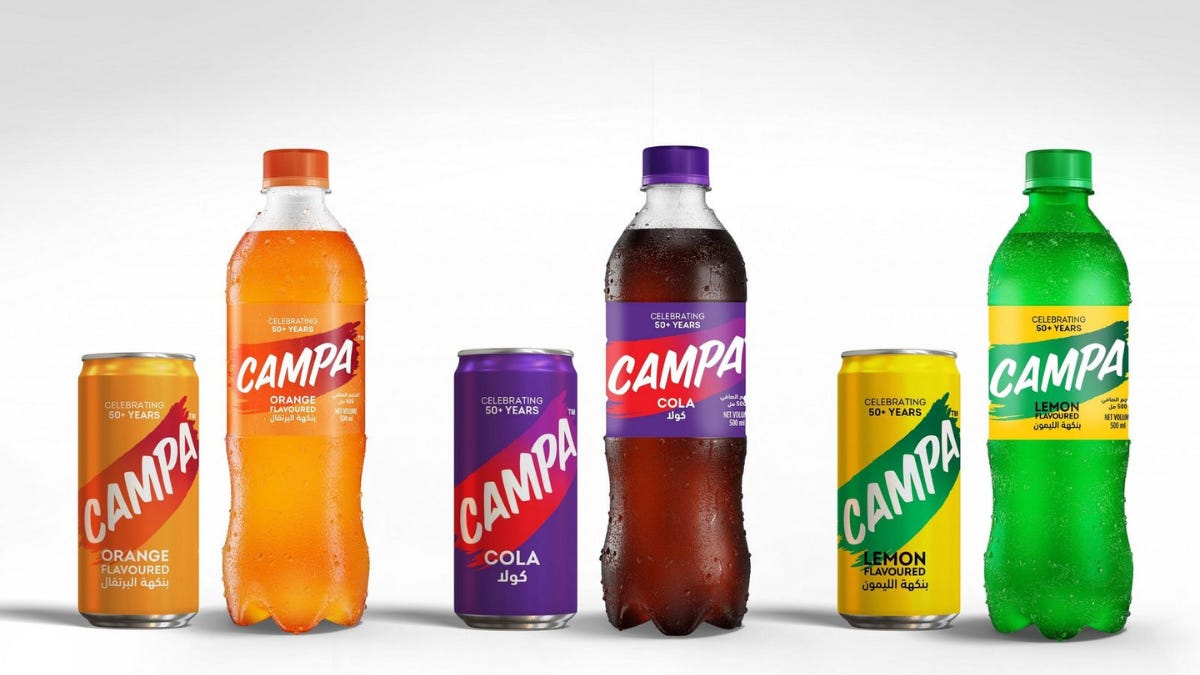
Colin here. One of the under-appreciated dynamics in global consumer markets is what happens when a brand doesn’t need to explain itself. Most challenger brands face an uphill narrative problem: They have to beg, borrow and steal to convince consumers to switch, to try something unfamiliar, to override habits.
Campa Cola, the Indian soft drink recently revived by Reliance Industries after nearly five decades, has none of that problem. It arrives pre-explained.
The short story: Coca-Cola chose to leave India in 1977, rather than comply with foreign-ownership rules. Campa filled the gap, becoming the default fizzy drink for an entire generation. Now Reliance, a powerful Indian conglomerate, has relaunched it with great distribution, aggressive pricing, and preferential shelf space across thousands of retail outlets and kirana shops, akin to neighborhood grocery stores.
Why is this interesting?
Part of this is nostalgia as a competitive advantage, and a form of brand infrastructure that multinational incumbents can’t replicate. Conventional wisdom in consumer goods has always been that global scale wins—that Coca-Cola’s distribution, consistency, and marketing budgets constitute an unassailable moat. And in stable geopolitical conditions, that’s generally true.
But the conditions aren’t stable anymore. In a period of fragmentation, declining trust in global systems, and rising local confidence, the CPG chessboard is reset.
Campa has Indian street cred. The story is already embedded in family memory, which turns out to be an influence vector that no amount of big brand spending can build from scratch. And this pattern isn’t uniquely Indian. Beijing’s revived Arctic Ocean soda leans on the same memory-and-place logic. In Russia, Baikal Cola filled gaps left by sanctions-driven exits.
The mechanisms vary—sentimental in some markets, purely functional in others—but the structural point is the same: when global coherence weakens, belonging beats mega branding.
What makes Campa different from a typical retro revival is that it’s backed by India’s most powerful industrial conglomerate. Reliance, controlled by the Ambani family, is a $250 billion empire that spans petrochemicals, telecom, and—crucially—retail. Through Reliance Retail, it operates tens of thousands of stores, and has deep relationships with millions of India’s small kirana shopkeepers, which together form the backbone of how most Indians actually buy things.
Reliance can price below incumbents indefinitely, control shelf placement, and slot Campa into an existing retail ecosystem that reaches further into daily Indian life than any multinational’s distribution network. It’s emotional legitimacy plus systems-level muscle, which is a combination most heritage brands never get.
For Coca-Cola and Pepsi, this isn’t an existential threat—they remain extraordinary at scale and consistency. But it marks something worth watching: the end of inevitability. Consumer goods have long been treated as politically neutral territory where the best-resourced global player wins by default. Campa suggests that in markets where local confidence is rising and memory runs deep, the default is no longer default. Soda, it turns out, is a canvas for soft power. (CJN)